A face that breathes.
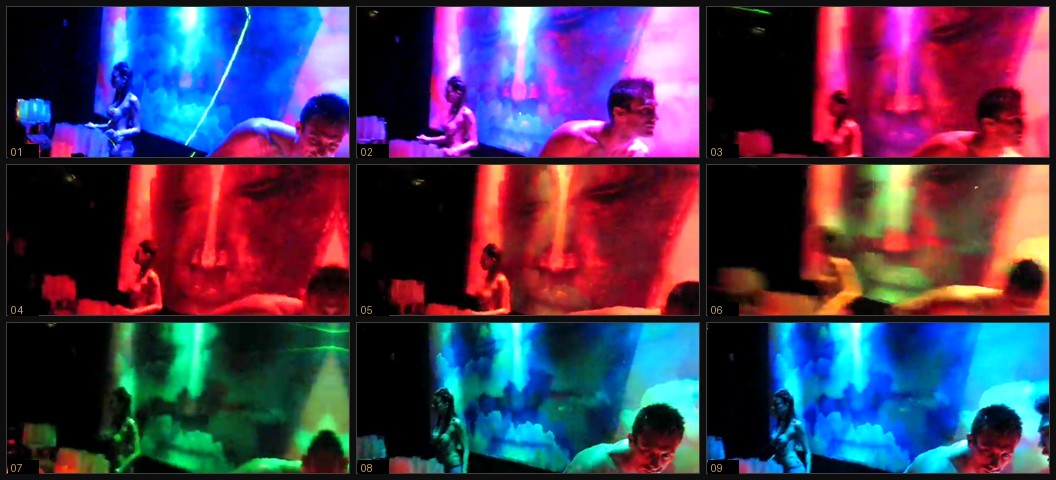
The head was designed digitally — then output not to a screen but to a large electrostatic inkjet print — four-color CMYK, the four-channel output that was all the printing of the day allowed (the same file today would run on a twelve-color latex printer). Here is the trick: with no light on it, there is no image at all — you genuinely cannot see it; the image stays hidden until you light it. Light is what brings it out. So as the room’s light moves across the surface, a serene head materializes out of a field of clouds in full color and, as the light moves off, dissolves back until it disappears completely — no seam, no cut, because the image was never switched “on.” Making the head vanish entirely into a wall of clouds was the illusion I set out to perfect. It was a tiny field then — only a handful of artists anywhere worked in light-revealed print, and I was the first to do it ultra-large-format. The disappearance was the hard part: getting the image to leave completely, nothing left but clouds, is the effect I chased down and cracked.
Built the display, then the art.
Not a slideshow on a monitor — and not off-the-shelf hardware, because there wasn't any yet. The giant board at Eden was built for the room from nothing: I manufactured the boards, sourced the blue LEDs, and engineered the pixel blending on the board itself — a custom LED arrangement that blends blue into white and full color, so a board built to be a sign renders like a television: high-resolution video, not a grid of dots. A small tweak to the engineering that changed what the wall could be. Pixel blending, before it had a name.
Before it was everywhere.
The large-format board I built for Eden was the first of its kind in a Miami nightclub — a full-color LED video wall in a room, years before you could buy one. A $220,000 build, engineered and installed from nothing in 2008–2010: manufacturing the boards, sourcing the LEDs, engineering the pixel layout, making the content, and installing it into the physical room. When it went in, even the national billboard networks were still running static, rotating panels — full-motion, full-color video on a wall was rare, and rarer still in a nightclub. Very few people were making architectural digital art then — and fewer still were building the displays to run it on.
And the wall was only half the idea. The other half was the model — a club’s video wall as content and a revenue channel at once: sponsor-funded programming that paid for itself, and live video links between rooms half a world apart — a New Year’s Eve feed running in real time between Miami, Ibiza, and Sydney — in the first-iPhone era, before a phone could even shoot video, let alone stream it. Today you can’t open a serious music venue without a video wall; being the one to put it in the club was the idea.
Two decades on, it's the same discipline that runs through everything else — make the space itself the medium, and design the experience someone walks into.